Sales & revenue
SDR and BDR, account executives, account management and revenue operations. Separate salary, commission and on-target earnings.
Sales careers & pay →An original analysis of observed adverts, with clear boundaries around what they tell us.
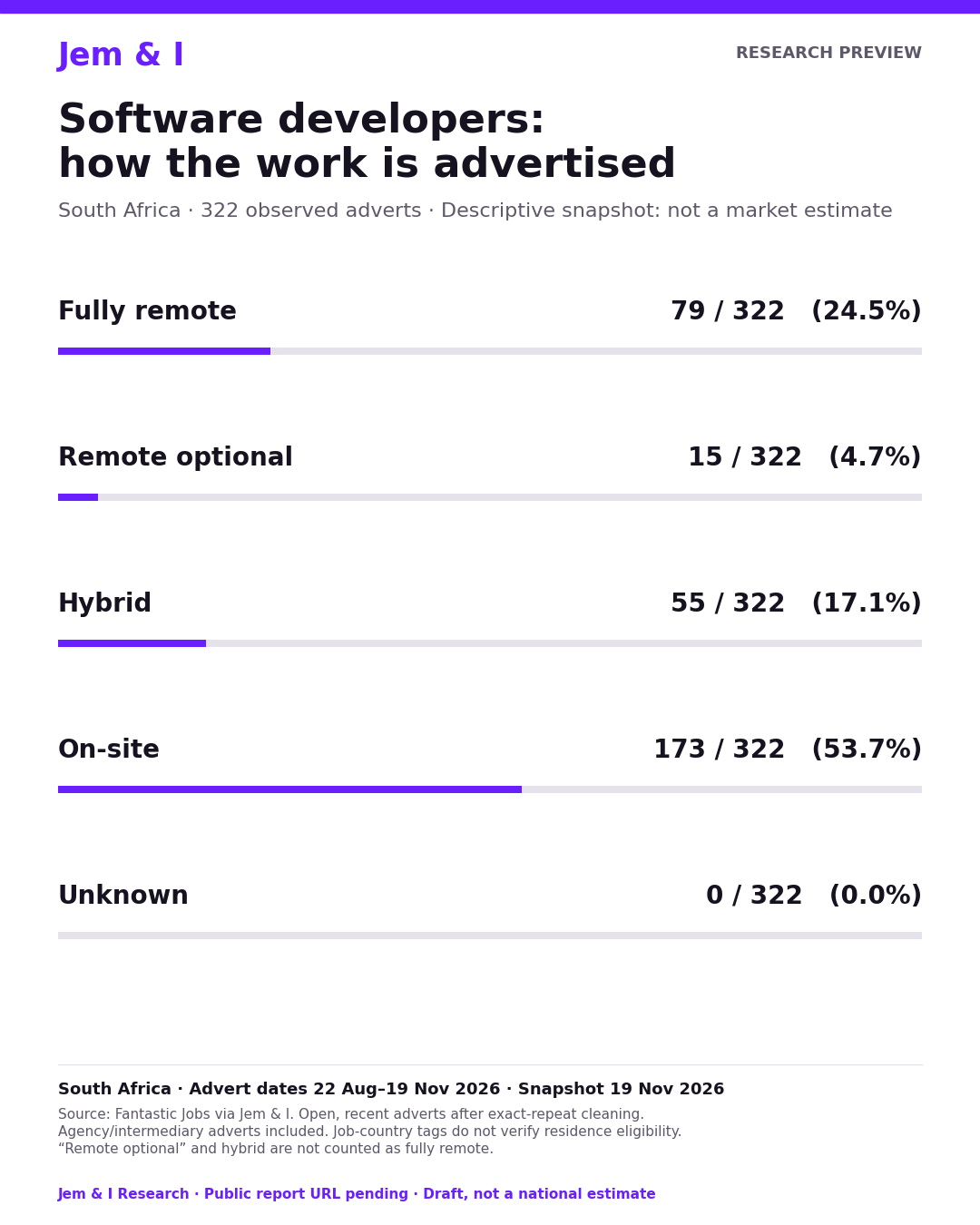
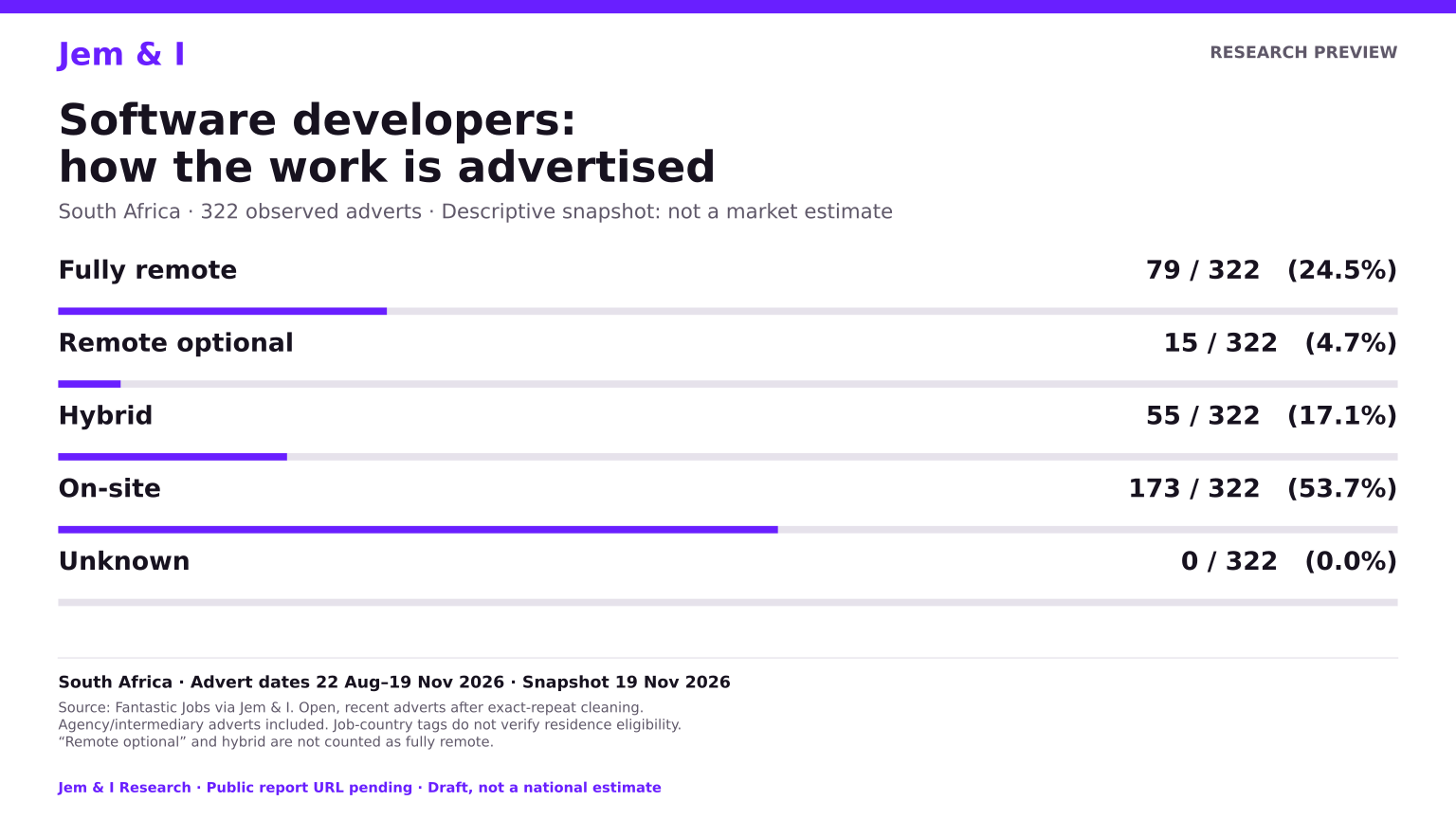
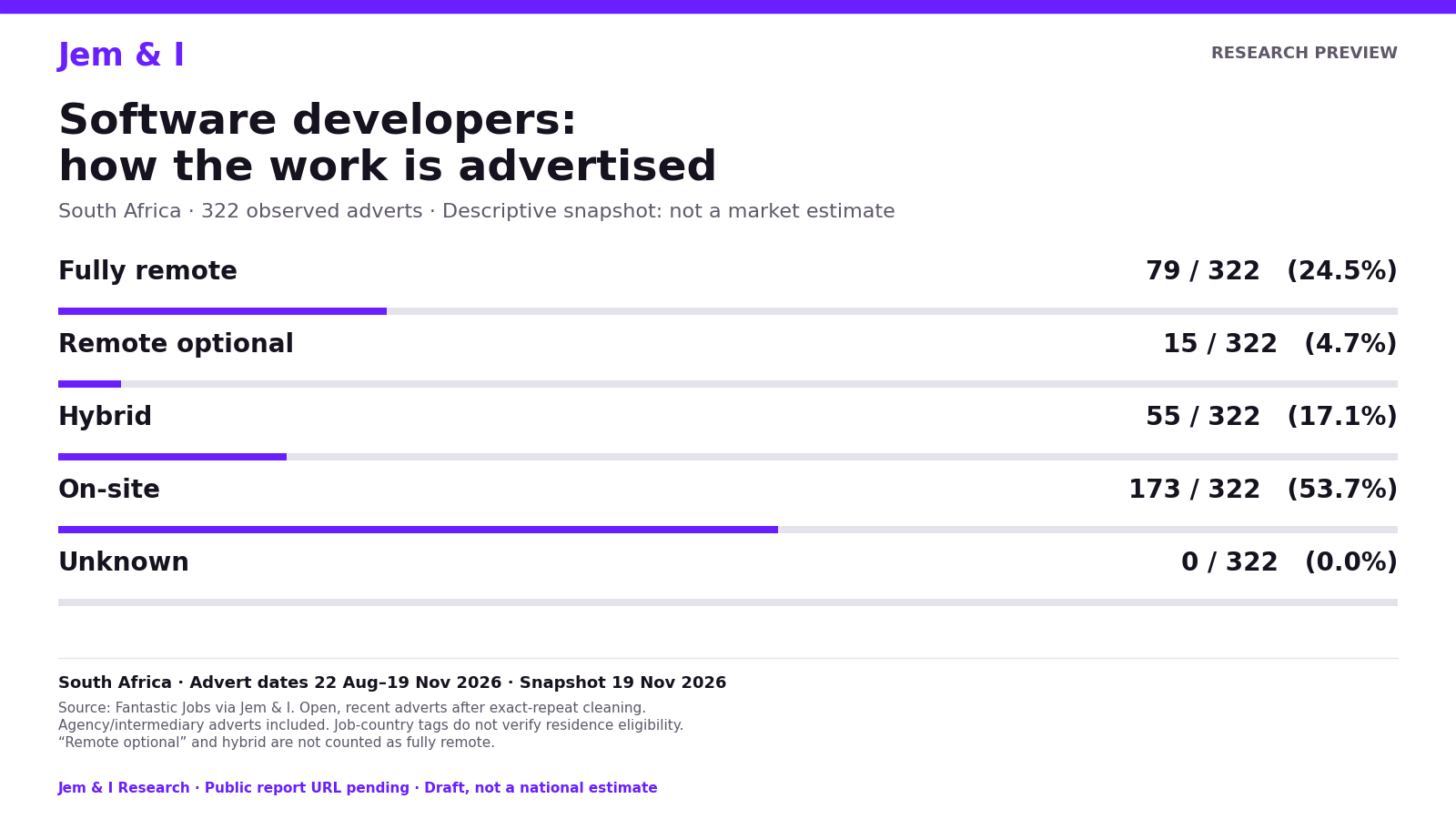
322 South Africa-tagged developer adverts · each square represents one advert
Convenience sample, 22 August–19 November 2026. Advert classification does not establish eligibility to work from South Africa. Not a national vacancy estimate. Jem & I · South African remote-advert audit
| Arrangement | Adverts |
|---|---|
| Fully remote | 79 |
| Remote optional | 15 |
| Hybrid | 55 |
| On-site | 173 |
SOUTH AFRICA / TECHNOLOGY · SALES · FINANCE
Explore professional sales and finance alongside technology: salary evidence, career responsibilities and the questions that make remote and fractional work viable.
SDR and BDR, account executives, account management and revenue operations. Separate salary, commission and on-target earnings.
Sales careers & pay →Bookkeeping, accounting, analysis and finance leadership. Compare responsibility and package definitions before comparing pay.
Finance careers & pay →Investigate scoped commercial projects and recurring finance support, including the cost of supervision and unpaid time.
Remote & fractional questions →JEM & I / RESEARCH & DECISIONS
Explore South Africa alongside Poland, Portugal, India, the Philippines, Kenya and Brazil.
Explore the professional talent comparison →Working-hours heatmap, professional salary ranges and a calculator using your actual offer. Candidate fit comes before location economics.
observed developer adverts were classified fully remote.
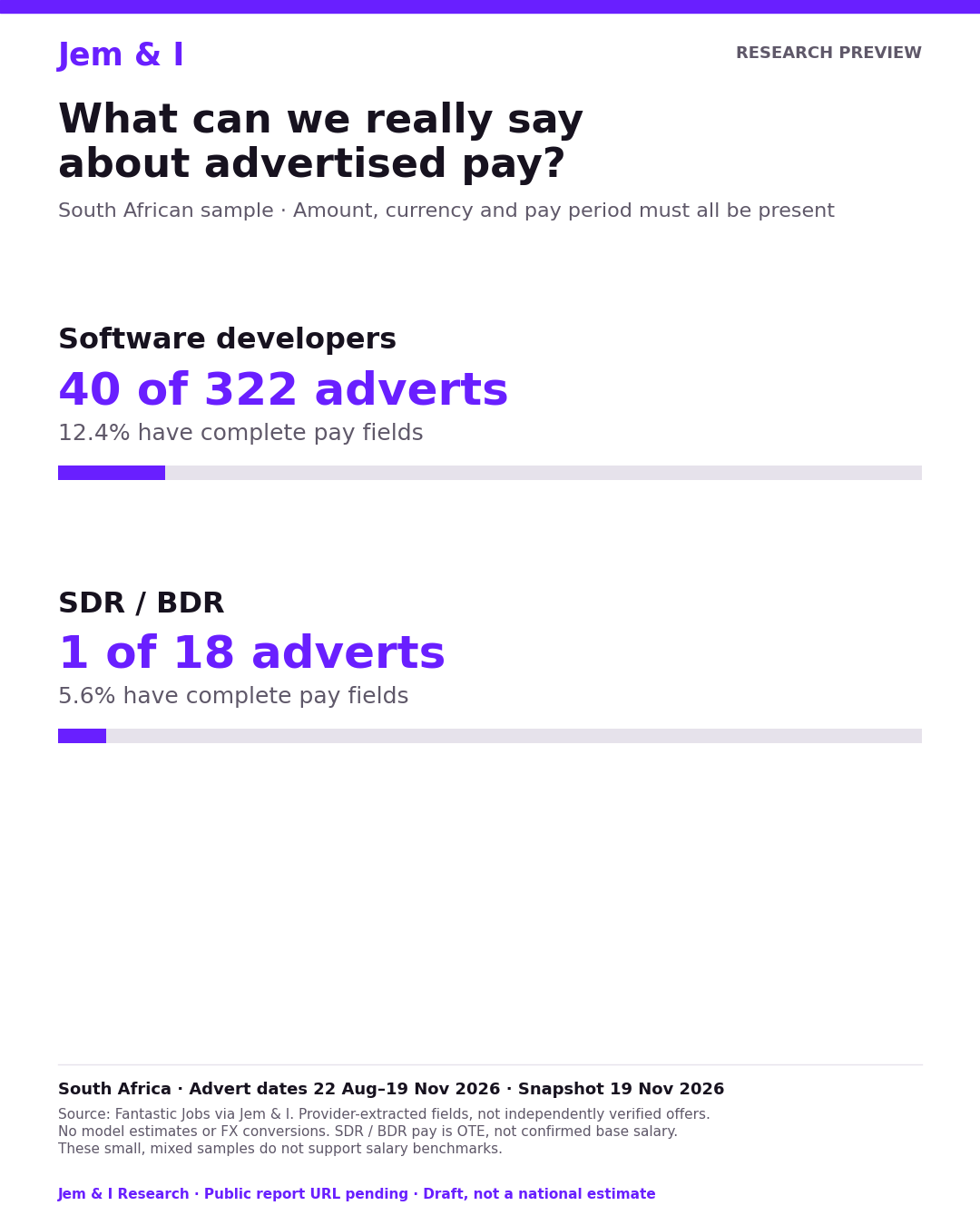
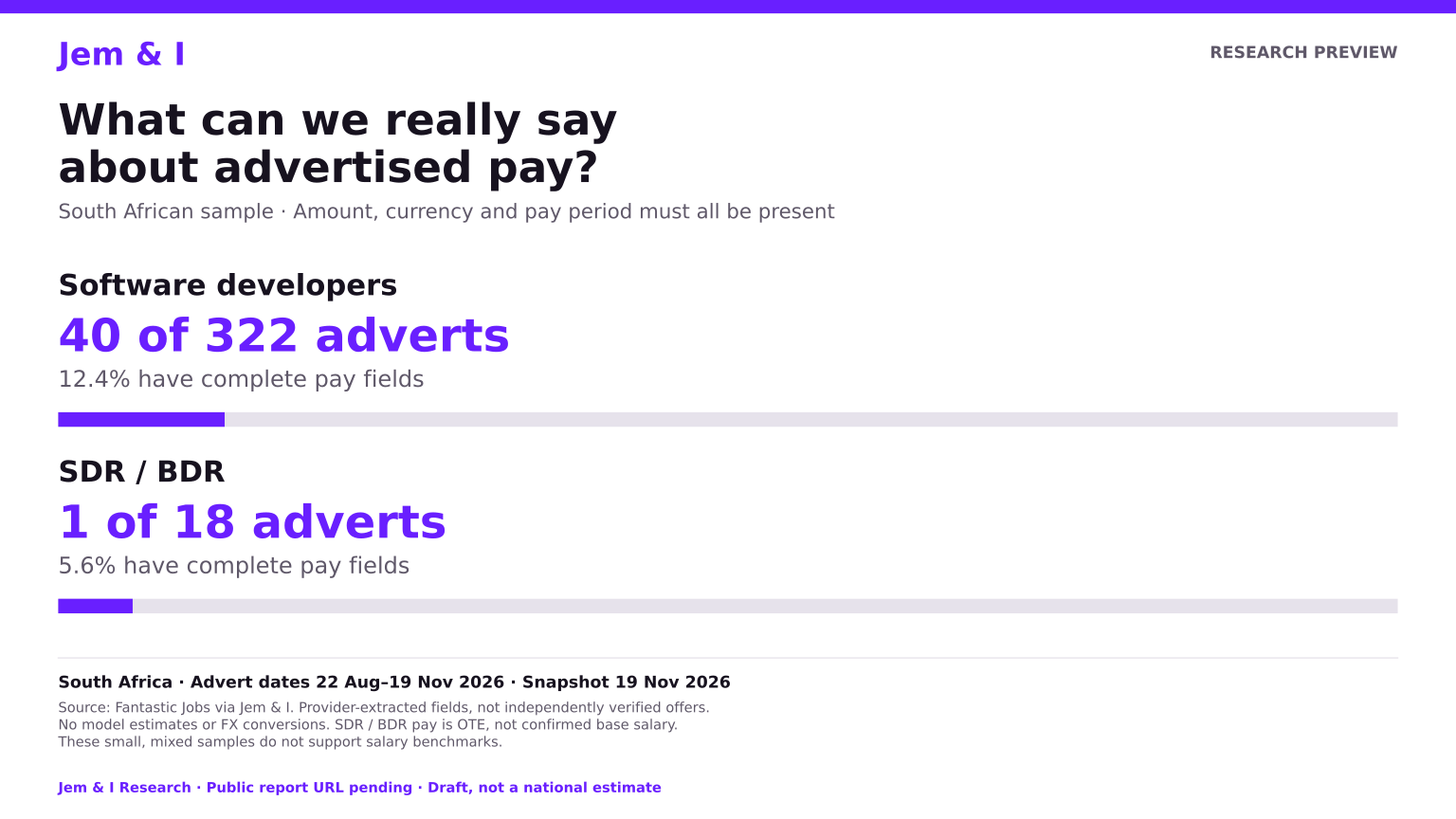
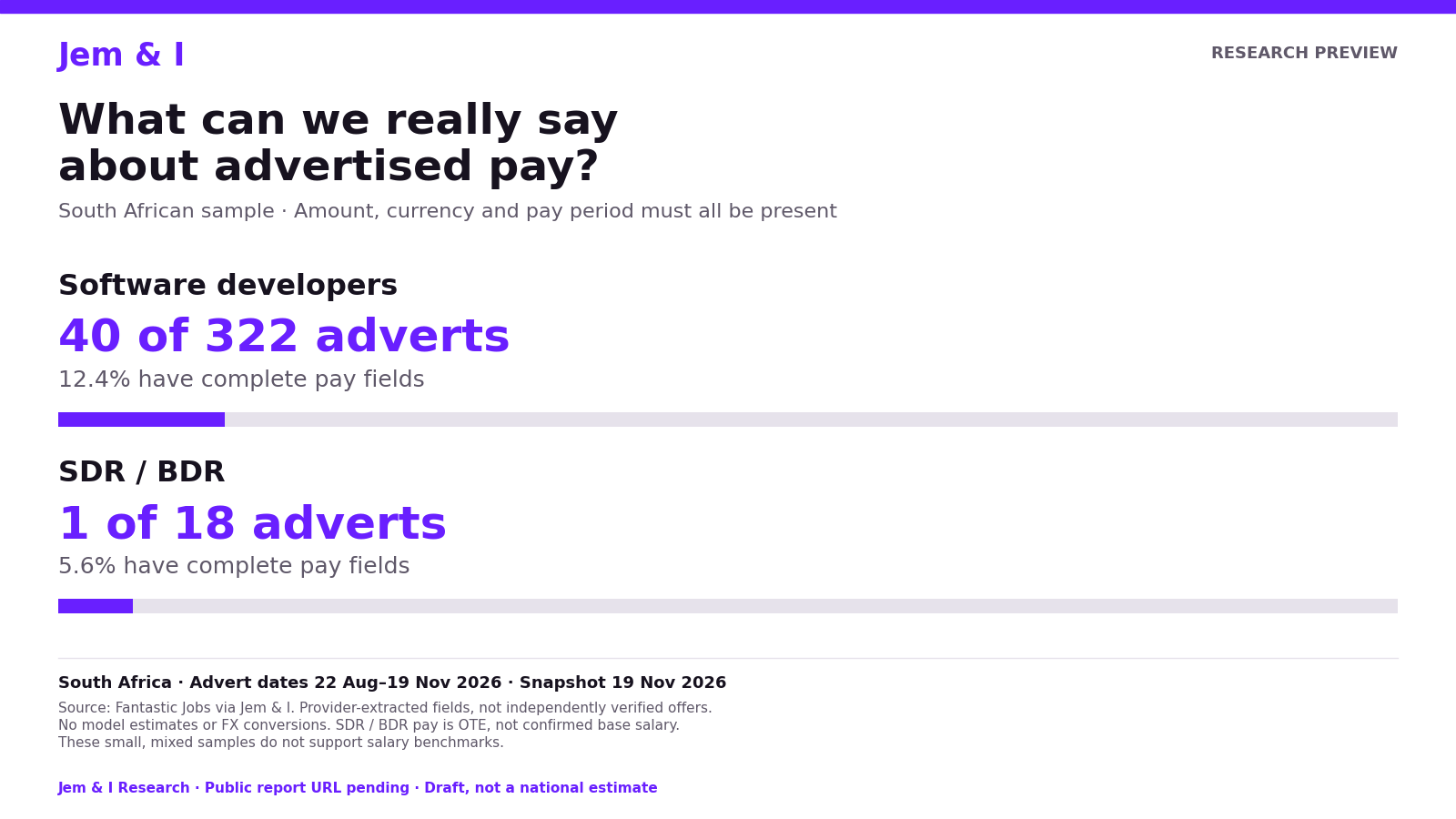
Snapshot 19 November 2026 · Advert dates 22 August–19 November 202640 of 322 records have complete extracted pay fields.
1 of 18 records have complete extracted pay fields.
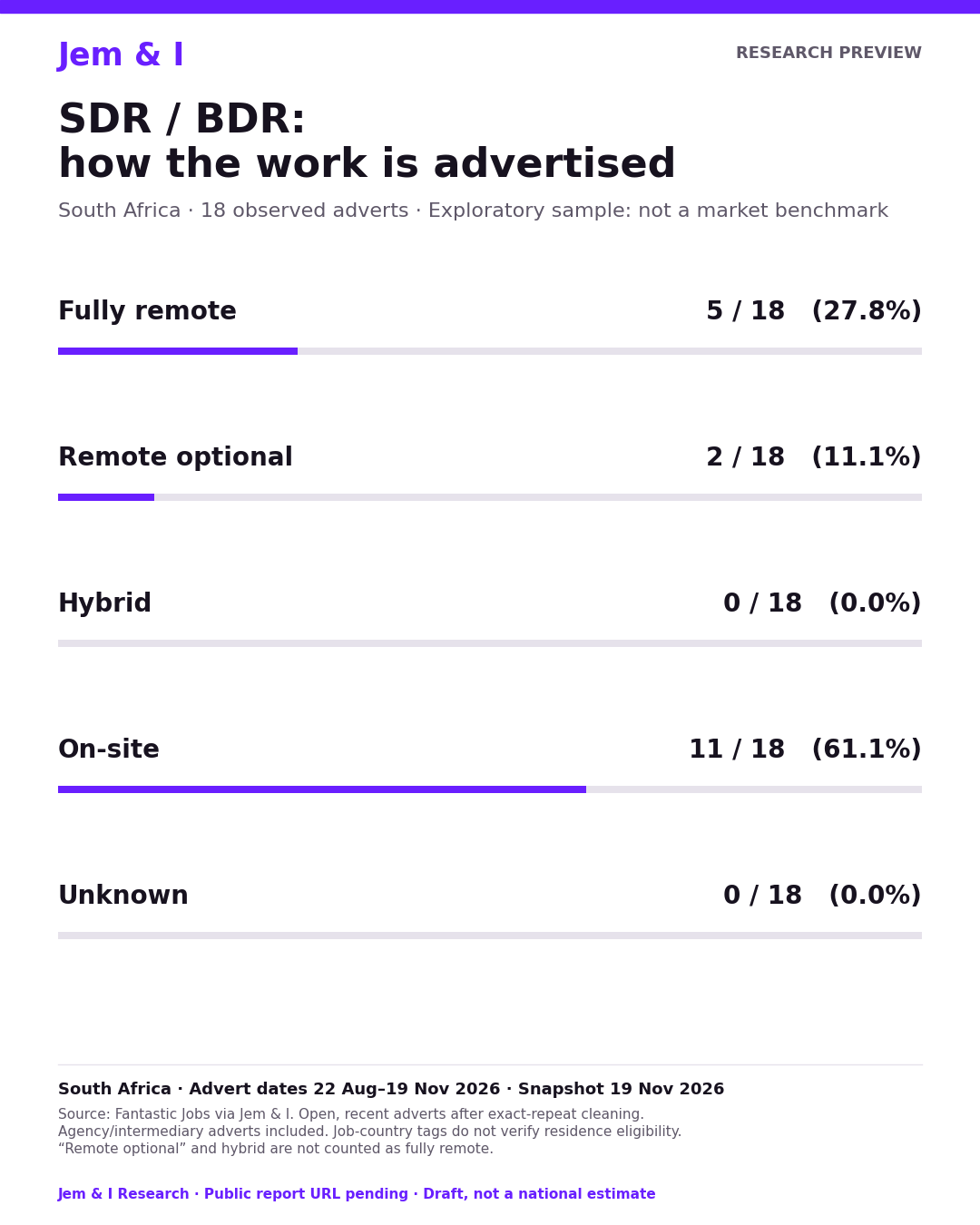
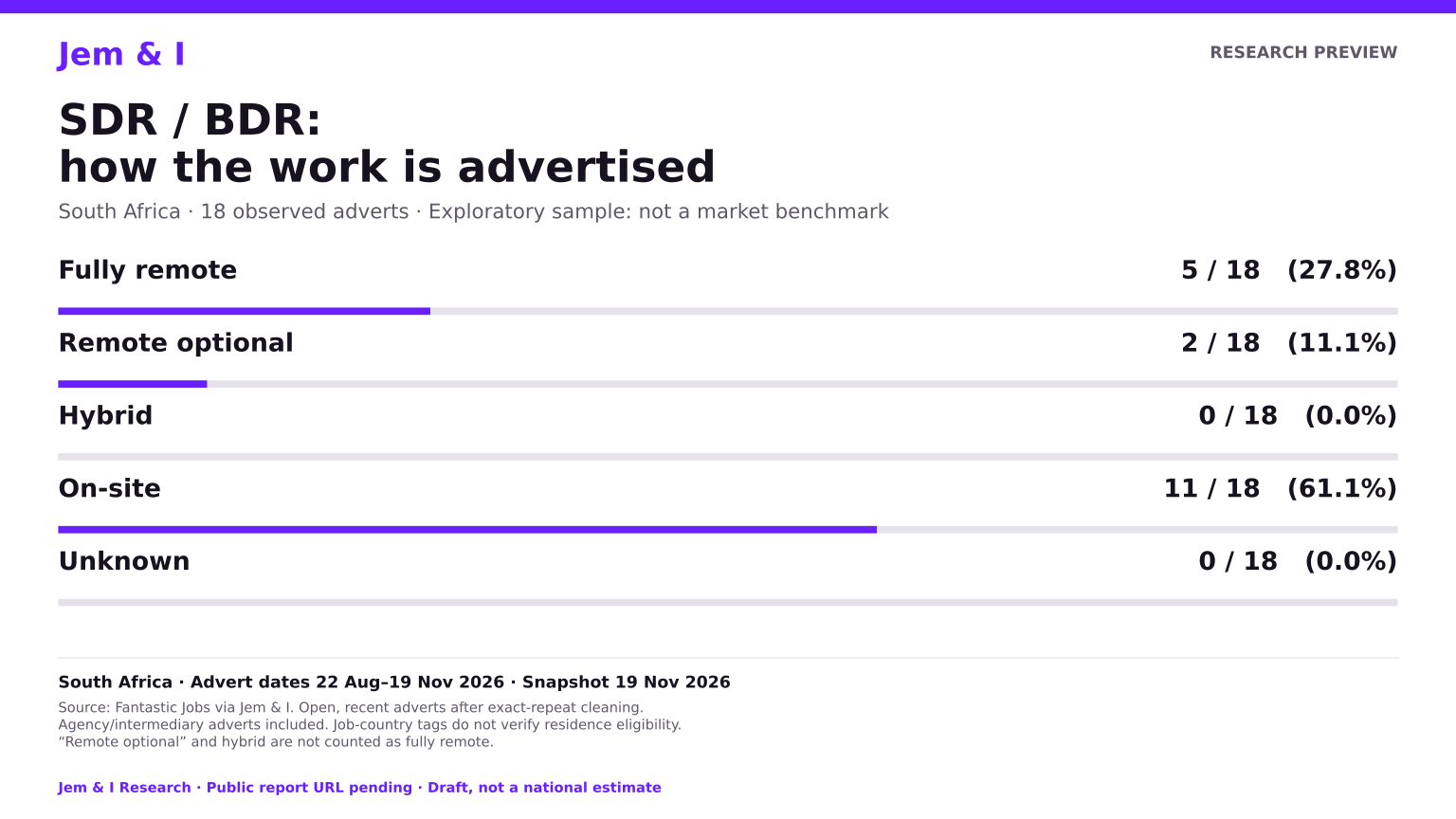
SDR/BDR has only 18 adverts; interpret its raw counts as exploratory. “Remote optional” is not combined with fully remote.
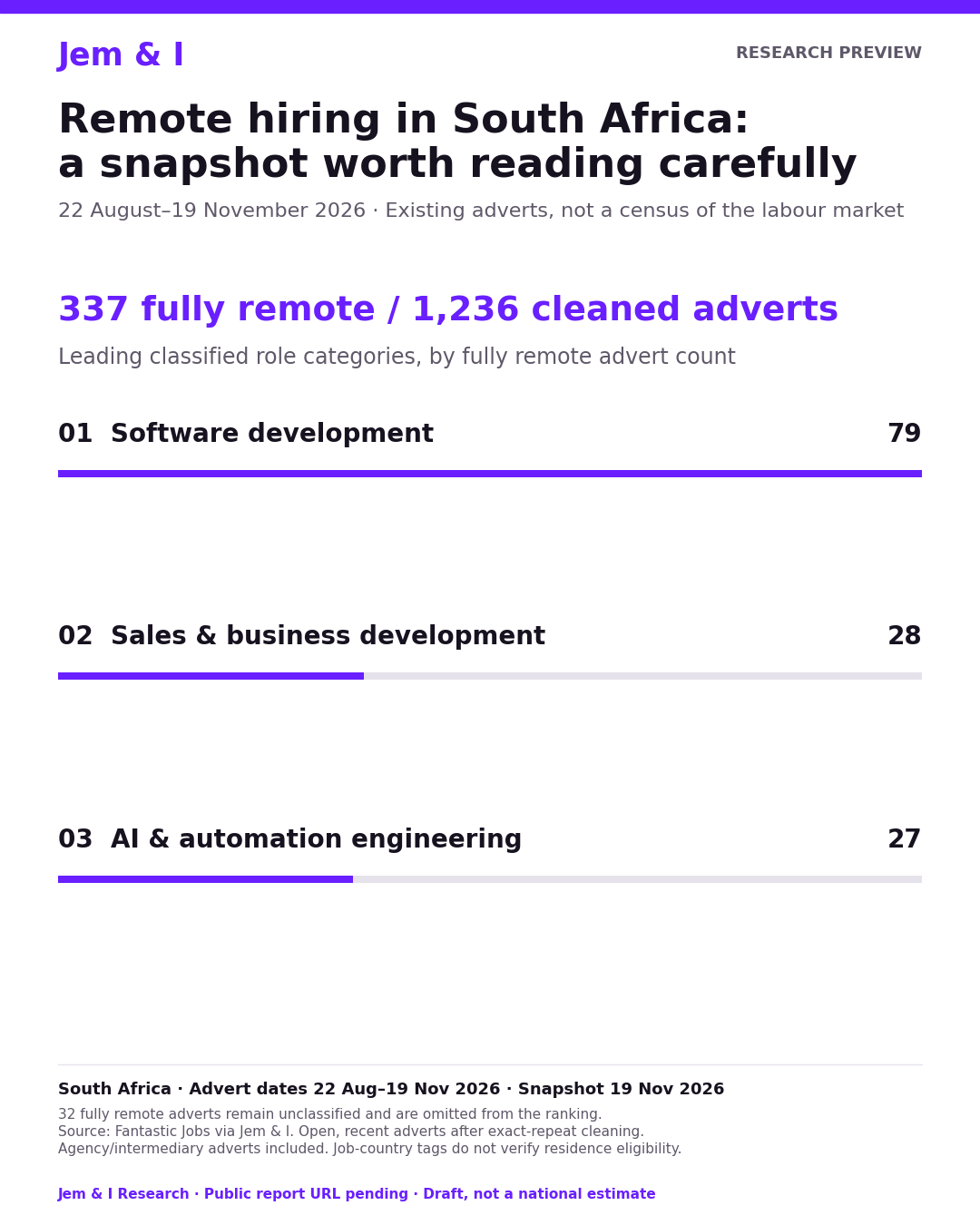
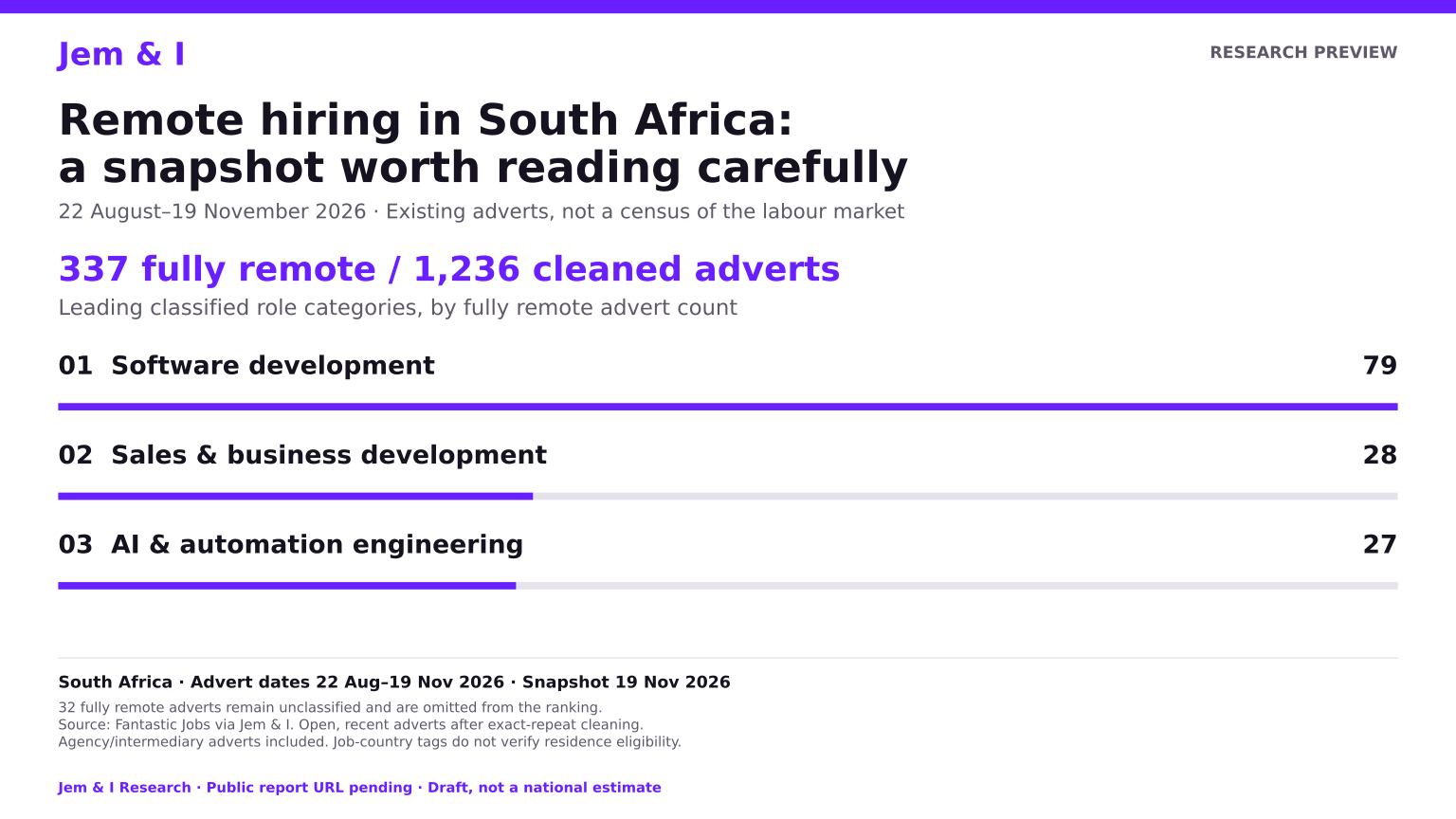
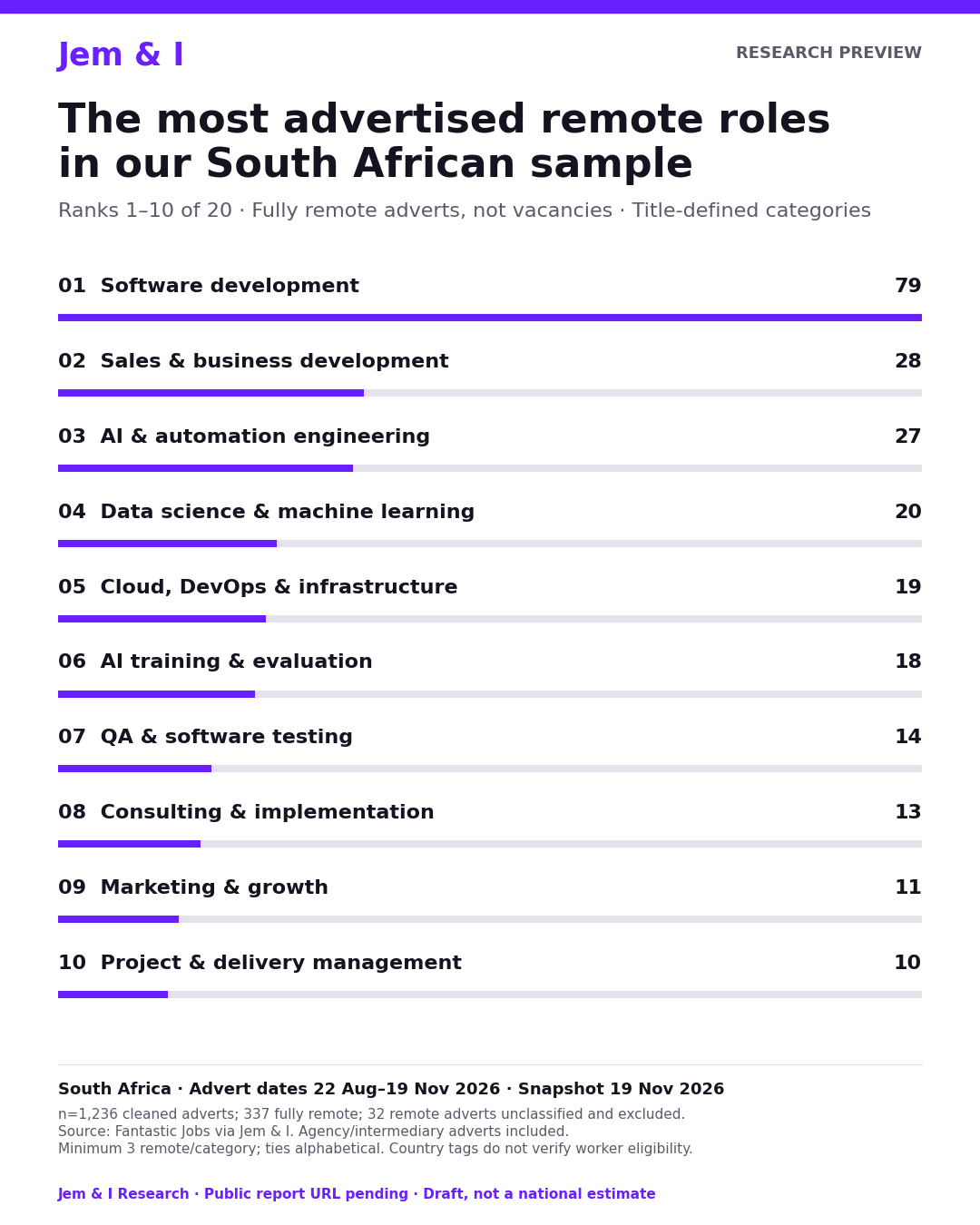
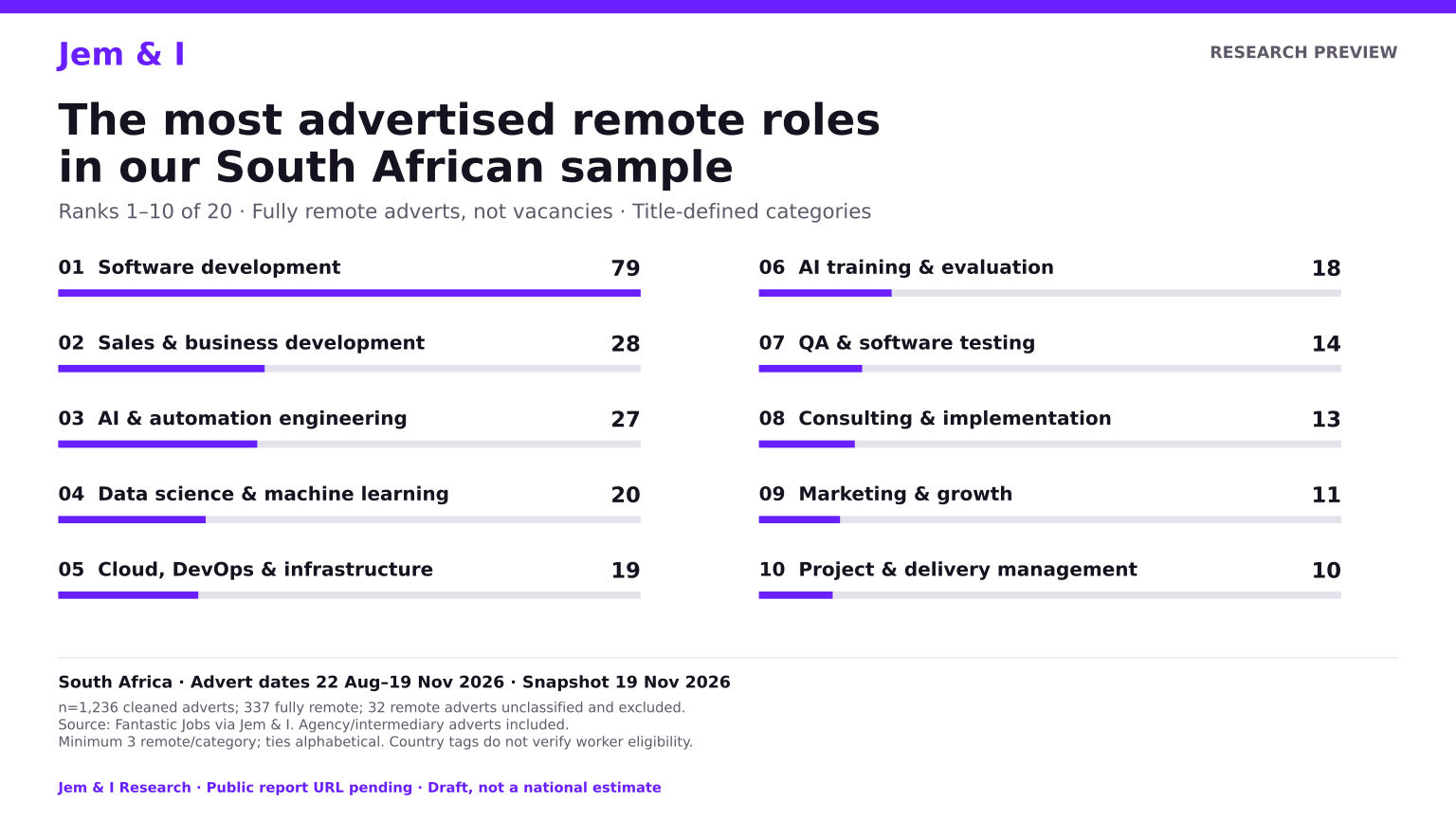
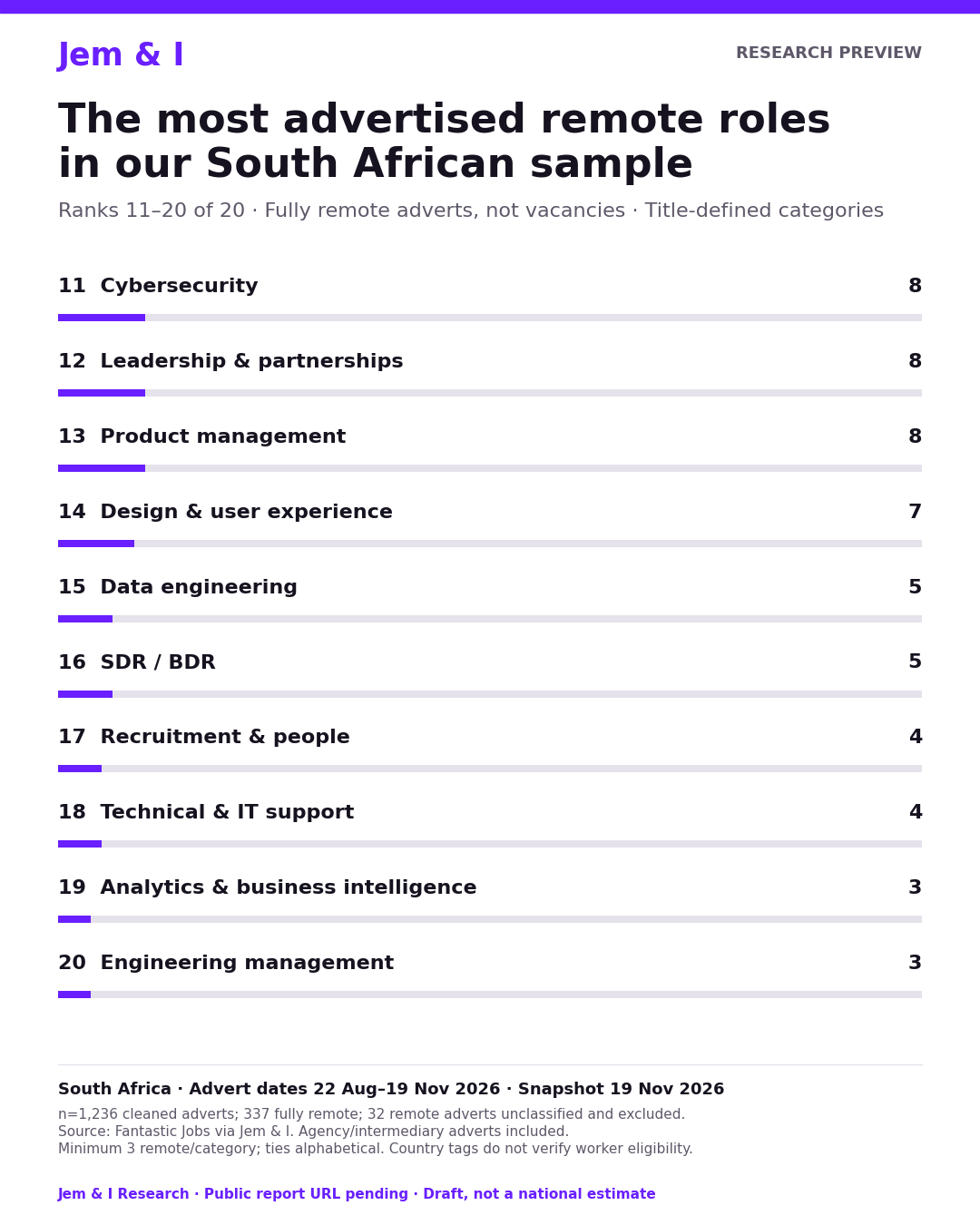
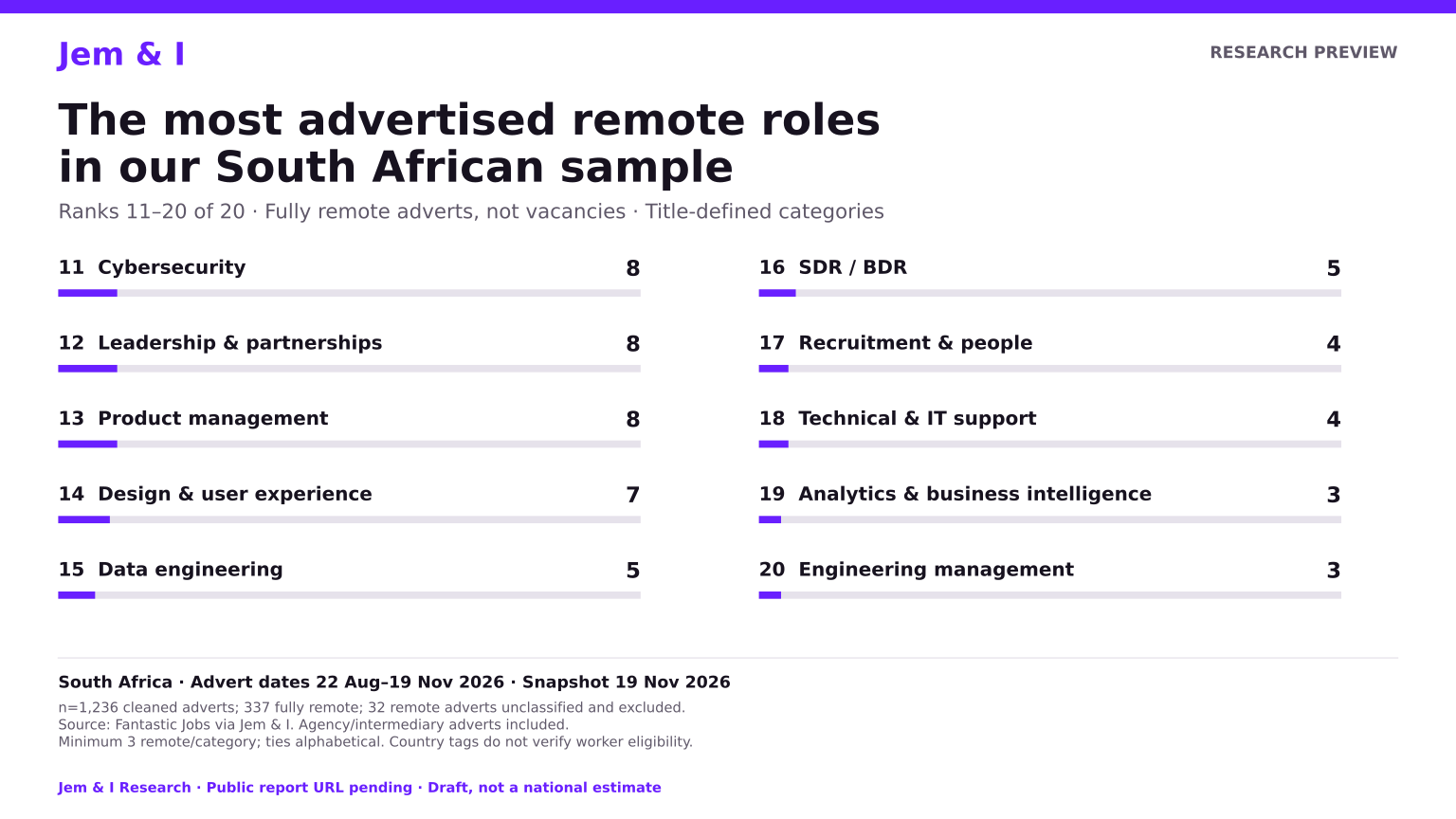
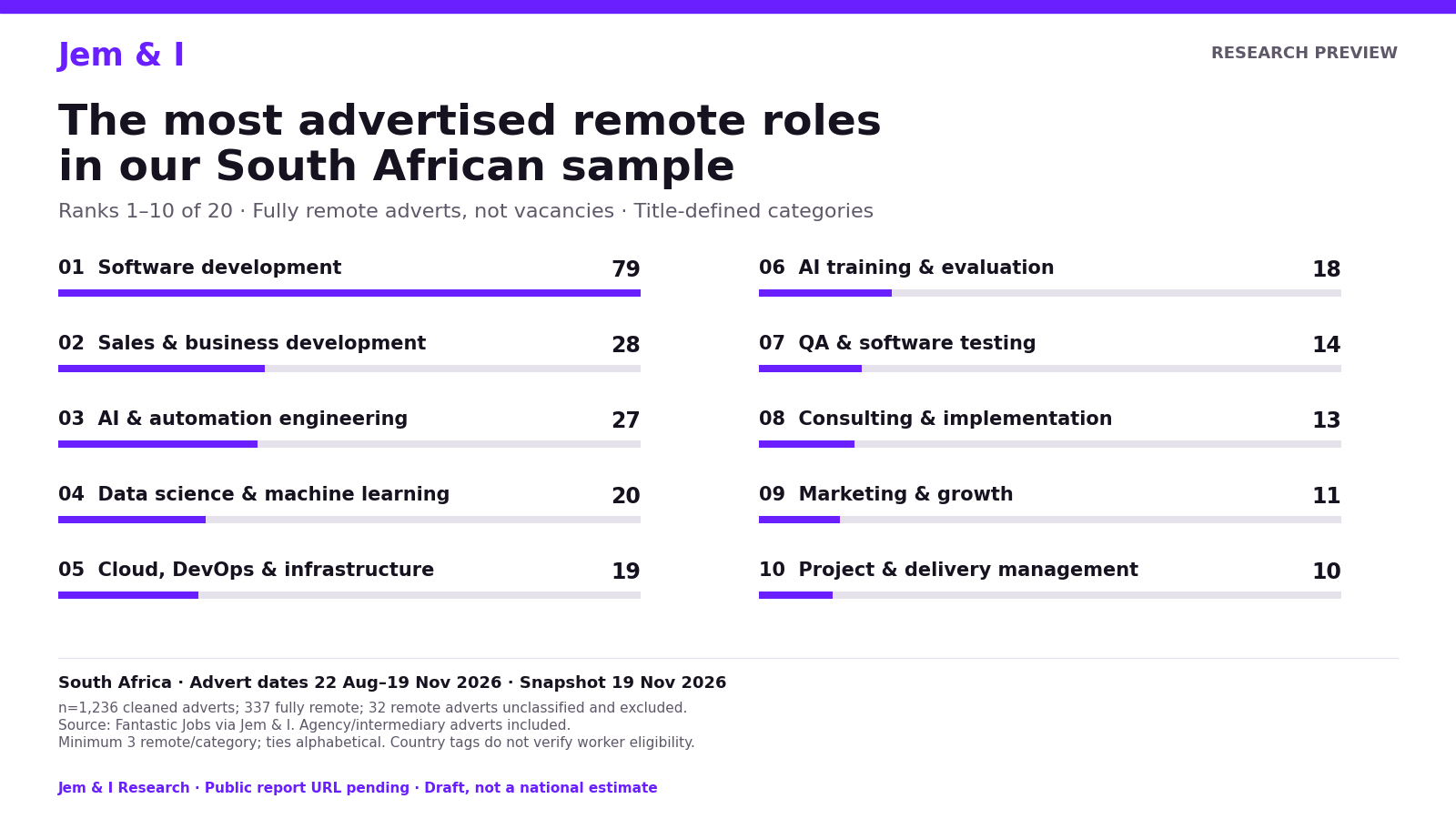
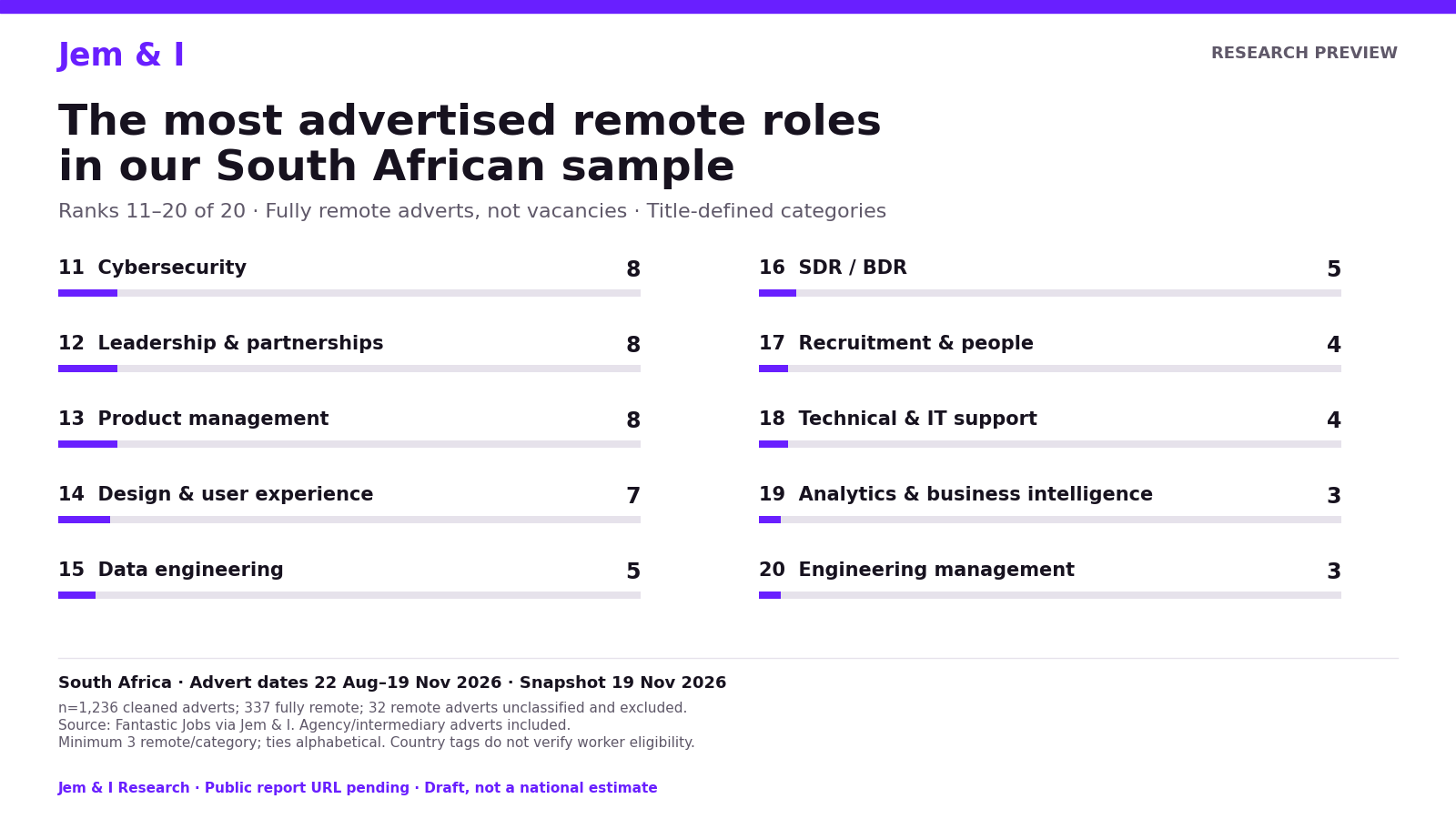
Source and limitations [D1]Most advertised classified remote roles in this sample. Ranked by fully remote count; hybrid and remote optional remain separate. At least three remote adverts is a display threshold, not a confidence threshold.
| Role category | Fully remote | All arrangements | Remote share |
|---|---|---|---|
| Software development | 79 | 322 | 24.5% |
| Sales & business development | 28 | 69 | 40.6% |
| AI & automation engineering | 27 | 70 | 38.6% |
| Data science & machine learning | 20 | 48 | 41.7% |
| Cloud, DevOps & infrastructure | 19 | 56 | 33.9% |
| AI training & evaluation | 18 | 19 | 94.7% |
| QA & software testing | 14 | 67 | 20.9% |
| Consulting & implementation | 13 | 47 | 27.7% |
| Marketing & growth | 11 | 24 | 45.8% |
| Project & delivery management | 10 | 35 | 28.6% |
| Cybersecurity | 8 | 19 | 42.1% |
| Leadership & partnerships | 8 | 10 | 80.0% |
| Product management | 8 | 28 | 28.6% |
| Design & user experience | 7 | 21 | 33.3% |
| Data engineering | 5 | 70 | 7.1% |
| SDR / BDR | 5 | 18 | 27.8% |
| Recruitment & people | 4 | 4 | 100.0% |
| Technical & IT support | 4 | 19 | 21.1% |
| Analytics & business intelligence | 3 | 32 | 9.4% |
| Engineering management | 3 | 19 | 15.8% |
Small denominators can produce striking percentages. These are observed counts, not national demand estimates.
Download ranking dataIs the role labelled remote, hybrid or office-based?
Which countries can the worker reside in, and what permissions are required?
What overlap, office attendance or shift pattern is expected?
Is the work permanent, part-time, fractional or project-based?
Our current audit establishes extracted location labels. It does not answer the remaining questions consistently. Remote adverts are not evidence of fractional demand.
Check residence eligibility and expected hours before investing in an application. Ask for the pay basis and whether the engagement offers the continuity you need.
Specify permitted locations, hours, engagement type and compensation clearly. The observed mix can inform a brief; it cannot predict hiring speed or the talent available.
Graphics use the same audited snapshot. Keep the date, denominator and source visible when sharing. These remain research previews.
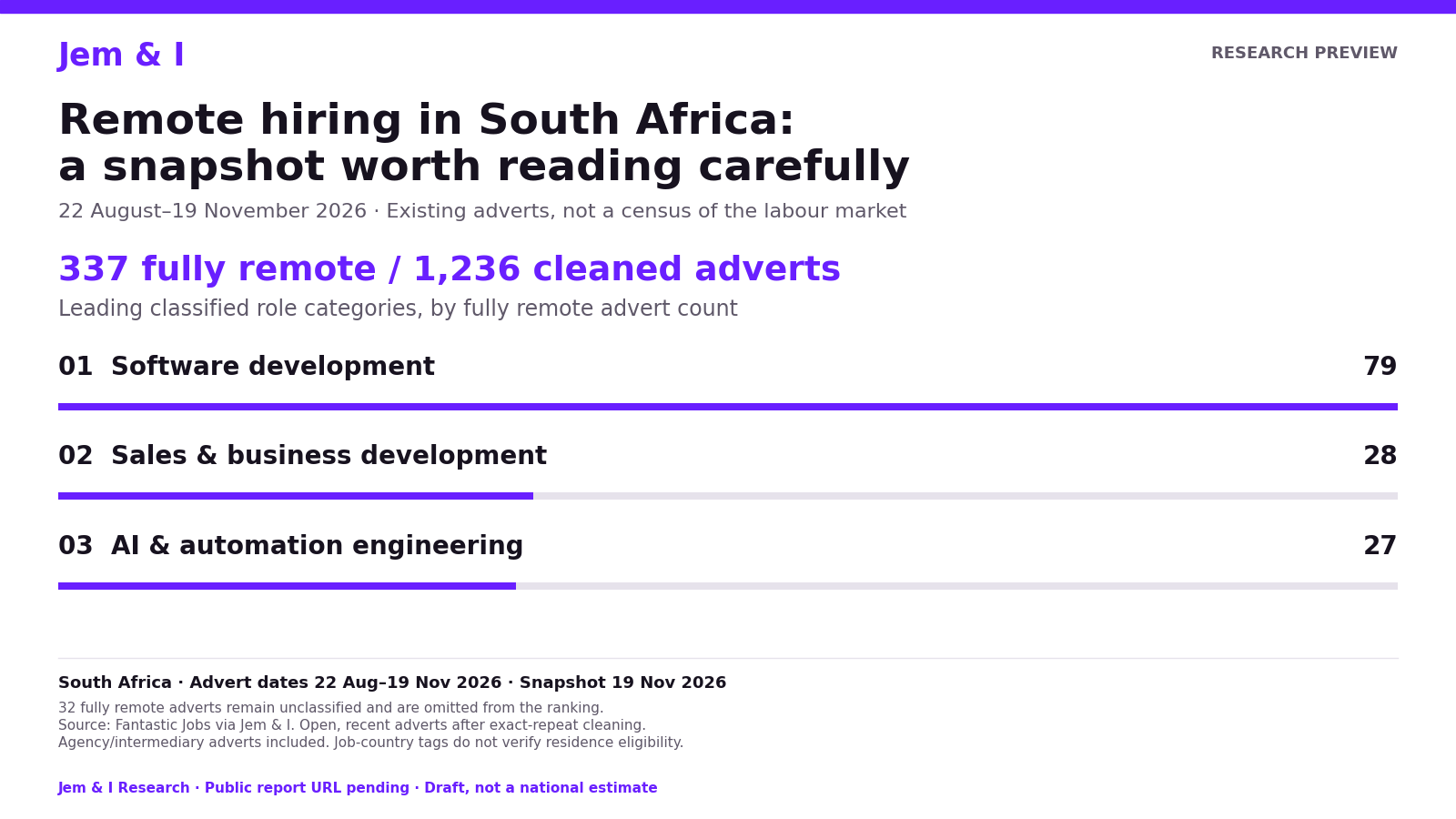
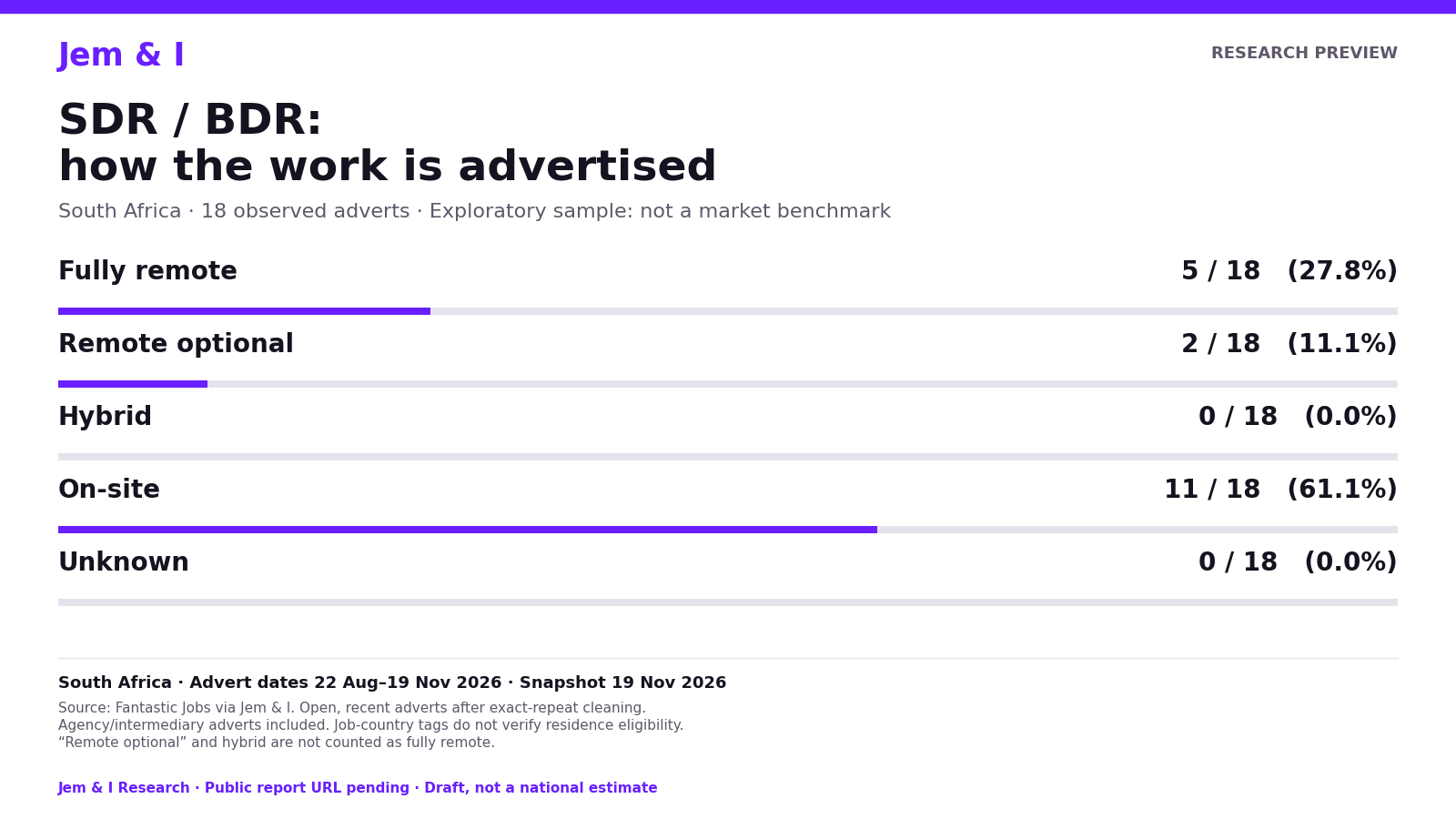
The full database audit covered 6,943 records. The report uses adverts marked open, posted within the window, excluding past stated expiry dates and specified unsuitable titles. Exact repeated descriptions within matching organisation and job attributes were collapsed. Near-duplicates and intermediary reposts may remain; adverts are not unique vacancies.
The broad cohort contains 1,236 cleaned South Africa-tagged adverts, including 337 classified fully remote. All come through Fantastic Jobs. Ranking categories use ordered title rules, not a standard occupation taxonomy. Thirty-two fully remote adverts remain unclassified and are excluded from the ranking. Categories differ in breadth.
Work-arrangement labels are provider-extracted, not independently verified. A South Africa job-country tag does not establish residence eligibility or permission to work from anywhere. Demand-driven collection and surviving open adverts do not provide a consistent historical panel; no growth trend is inferred.
Complete pay fields mean an extracted amount, currency and period—not a verified offer or base salary. Missing fields may reflect extraction, not employer non-disclosure. The single complete SDR/BDR record is OTE. No salary benchmark, remote premium or international cost ranking is presented.
Source and limitations [D1]NEXT RESEARCH CUT / SALES · FINANCE · TECHNOLOGY
A job posted in another country may be remote yet unavailable to a South African applicant. Eligibility must be measured separately from the employer’s location.
Record explicit country restrictions, required overlap, employment or contractor terms and pay disclosure. Keep unclear eligibility in an “unknown” category. This is the proposed classification, not a measured conversion funnel.
Fantastic.jobs coverage documentation supports sizing the sample; People Data Labs documents company-career-page data and role/geographic insights. Neither establishes South African remote eligibility without inspecting the underlying adverts.
Sources and measurement limits →Produced by Jem & I Research: original job-ad analysis, attributed published research and clearly labelled interpretation. This preview contains no original candidate salary or preference survey. How the evidence is attributed ↗
SOUTH AFRICAN TECH / CANDIDATE SIGNAL
37% of respondents reported becoming more open to working remotely for international companies in the OfferZen 2026 survey. Openness is different from accepting an offer, securing work or earning a foreign salary.
For candidates, compare the full package and required hours. For employers, test actual availability and role fit rather than assuming a national talent pool is available on demand.
OfferZen 2026 Salary and Benefits Report, p. 12. Self-selected South African tech respondents; multiple responses allowed; question-specific count unavailable.
How to compare remote pay →