

Jem & I
PublisherCandidate-first AI recruiter; native network search and headhunting.
Sources: [M6] · [M7] · [M9]A field guide to job boards, personal AI, sourcing agents and recruiters—and the choices that still belong to people.
Jem’s candidate-first positioning within a wider market of approaches.
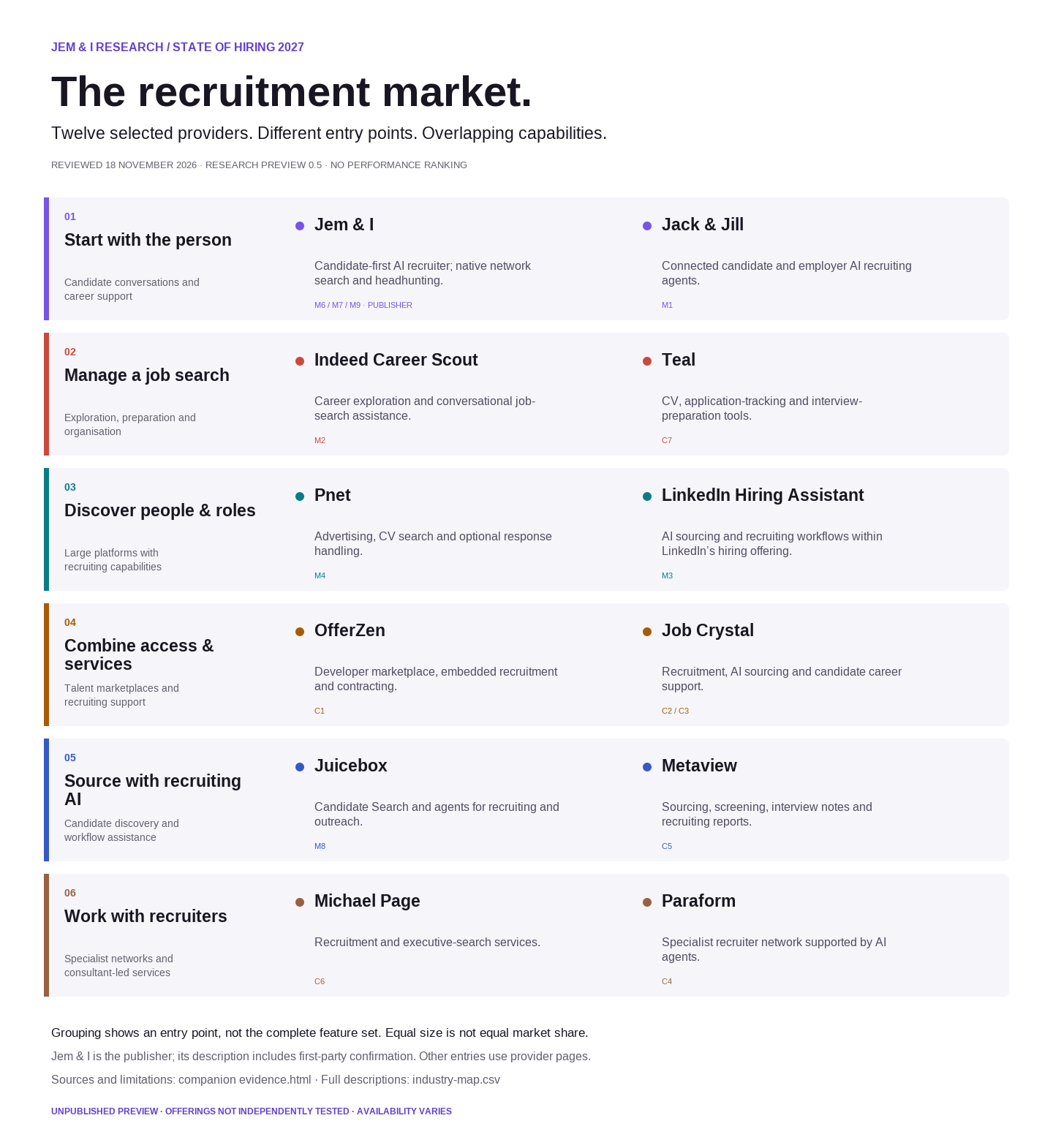
Conceptual grouping of selected offerings. Connections are not integrations, measured relationships or endorsements. Jem & I is the publisher; its positioning is self-described. Jem & I · Publisher product description · Jack & Jill · Product overview · Indeed · Career Scout · Teal · Pnet · Recruitment solutions · LinkedIn · Hiring Assistant · OfferZen · Job Crystal · Juicebox · Company and product facts · Metaview · Michael Page Africa · Paraform
Selected companies discussed below. Identification only; no affiliation or endorsement implied.
Twelve familiar and emerging alternatives, organised around the work they help people do. Several combine software, AI and human services.
All 12 selected providers. Groupings show an entry point into the offering; capabilities can span several groups.
Candidate conversations and career support
Exploration, preparation and organisation
Large platforms with recruiting capabilities
Talent marketplaces and recruiting support
Candidate discovery and workflow assistance
Specialist networks and consultant-led services
Direct applications, referrals, your own network, email and general-purpose AI remain valid routes. They trade service support for personal control and effort. The comparison below includes them.
A job board may offer AI assistance. A sourcing platform may coordinate outreach. A recruiter may combine software and services. Look at the work, then the evidence.
These are patterns in the offerings reviewed, not measured adoption trends.
Explore six patterns and the unanswered questions →Sources: [M2] · [M4] · [C1] · [M8] · [C5] · [C14] · [C18]The same activity can be done by a person, software or a service. Agree who owns it before judging what the technology saves.
| Approach | Set the brief | Discover options | Check interest | Arrange next step | Make the decision |
|---|---|---|---|---|---|
| DIY search | You | You | You | You | You |
| AI-assisted search | You | Shared | You | Shared | You |
| Recruiting service | Shared | Delegated | Shared | Delegated | You |
| Approach | Set the brief | Discover options | Check interest | Arrange next step | Make the decision |
|---|---|---|---|---|---|
| Job board + team | Team | Team | Team | Team | Team |
| Recruiting AI tools | Shared | Delegated | Shared | Shared | Team |
| Recruiting service | Shared | Delegated | Delegated | Delegated | Team |
Illustrative operating models, not measured provider capabilities. “Shared” means support or collaboration; “delegated” means an agreed task is carried out on your behalf, with oversight as needed. Product settings and service agreements change the division. An AI tool can delegate substantial work; a recruiter can still leave tasks with you. Candidates decide whether to pursue or accept; employers own hiring decisions.
There is no universal winner. The right combination depends on the search, the people involved and the capacity to manage it.
| Approach | Potential value | Trade-off to examine | Question to ask |
|---|---|---|---|
| Job boards & networks | Access to advertised opportunities and established recruiting audiences. | Finding signal, checking fit and managing responses can remain substantial work. Some platforms offer help with these tasks. | How will we distinguish a good match from another application? |
| General AI + DIY | Flexible help drafting, researching and organising a search. | People still need to verify information, supply context and coordinate the process; integrations change what can be delegated. | Who checks accuracy and owns the next step? |
| Employer sourcing platforms | Dedicated candidate discovery and outreach workflows, with varying degrees of automation. | Search calibration, candidate interest and hiring judgement still matter. Automation is not evidence that candidates want the role. | Can we see why each person was suggested and manage outreach responsibly? |
| Recruitment services | An external party can own agreed sourcing and coordination work. | Scope, incentives, coverage and service quality vary; the client and candidate still make their decisions. | What is included, who is accountable and how is success measured? |
| Candidate-first AI recruiting | Career context can inform opportunity discovery alongside employer search capability. | Candidate-first is a commitment to examine, not proof of better outcomes. Payer interests, preferences and introduction decisions need clarity. | Does the service understand what the person wants, including reasons to say no? |
Editorial decision framework, informed by the offering review. These are questions and possible trade-offs, not estimates of effectiveness.
A clear purpose, with native sourcing and headhunting for employers. The distinction should be visible in the candidate experience.
Jem is a candidate-first AI recruiter. Hiring managers and talent acquisition teams can also speak to her to find candidates in her network or ask her to headhunt. Those sourcing capabilities are native to Jem.
Candidate support and conversational sourcing both exist elsewhere in this landscape. Our position is to bring them together around the person’s next move.
Sources: [M6] · [M7] · [M9]Bring your goals, preferences and questions. Ask how your information is shared and how you can update or decline opportunities.
Explore Jem for candidates ↗Discuss the brief with Jem, explore her network or request headhunting. Ask how candidate interest and fit are established.
Explore Jem for hiring teams ↗First-party positioning and capability confirmation, not an independently tested superiority claim. Full feature parity with Juicebox or other providers is not implied. Candidate effort, experience, match quality and long-term outcomes remain matters for comparative research.
These can be different people. A useful comparison makes the relationship clear without assuming that one payment model always produces better results.
A candidate, recruiter or hiring manager supplies goals, context and feedback.
An employer, agency or individual may fund access, a service or a completed placement.
People decide whether to proceed. The process should make their choices and responsibilities clear.
Ask what the fee rewards: access, activity, an introduction, a hire or an ongoing service. Check how the provider handles a mismatch between a paying client’s request and a candidate’s preferences. This chapter does not compare prices; scope and current commercial terms need separate verification.
Email can work well for both DIY hiring and AI-assisted recruitment. Its usefulness depends on the process around it.
These are practical design considerations, not measured failure rates. A well-managed inbox with supporting tools can work effectively. AI can also operate through email: Juicebox describes mailbox connections and outreach workflows. The distinction is process ownership, not whether a message arrives in an inbox.
Sources: [M8]More profiles or messages do not establish a better outcome. A useful benchmark follows both sides of the process.
Track candidate and employer hours separately, then together, per mutually accepted introduction. Include review, coordination and correcting errors.
Record preferences, permission to introduce, reasons to decline and whether people understood the next step. Do not equate a reply with interest.
Follow interviews, offers, starts, early exits and both sides’ experience. Report denominators, missing responses and differences in role mix.
Compare matched roles and candidate groups across approaches. Predefine success, measures and analysis; establish sample size from the study design. An observational comparison cannot by itself prove that AI caused a difference.
Concise answers, with the same evidence boundaries as the full chapter.
This review does not establish replacement. It shows overlapping approaches: platforms add AI or services, and recruiters use sourcing software. Choose based on the work required and the outcome evidence.
Both belong in a conversation about conversational candidate sourcing. Juicebox describes an employer recruiting platform. Jem & I is candidate-first and also has native network search and headhunting for hiring managers and talent acquisition teams. This is an offering comparison, not proof of feature parity or superior results.
Sources: [M8] · [M9]No. Jem’s confirmed offering includes employer-facing sourcing and headhunting. Candidate-first describes her orientation toward the person seeking work, not a restriction on who can use her.
Sources: [M9]Ask who sets the brief, checks relevance, establishes interest, handles outreach, updates status and resolves problems. Then assess integration needs, scope, cost and evidence from comparable roles.
Reviewed 18 November 2026. A selected landscape, not a census or a league table.
The main map includes twelve recognisable or strategically relevant alternatives across six approaches. The wider directory adds regional discovery, flexible work, AI expert work and recruiting infrastructure.
Descriptions use provider pages and dated Jem founder confirmation. They establish how an offering is described, not independently verified performance. Missing features are not treated as absent.
Jem & I publishes this report and appears in the map. There are no paid placements, numerical scores or claimed market-share positions in this working edition. Availability, terms and prices require separate checks.
Map categories are editorial and can overlap. No product trials, customer-review audit or global availability study was conducted. Trends are labelled as offering patterns, announcements or research questions. This November preview is not a completed end-of-2026 study.
Produced by Jem & I Research: original job-ad analysis, attributed published research and clearly labelled interpretation. This preview contains no original candidate salary or preference survey. How the evidence is attributed ↗